Friday, April 1, 2016

Bias Score Analysis

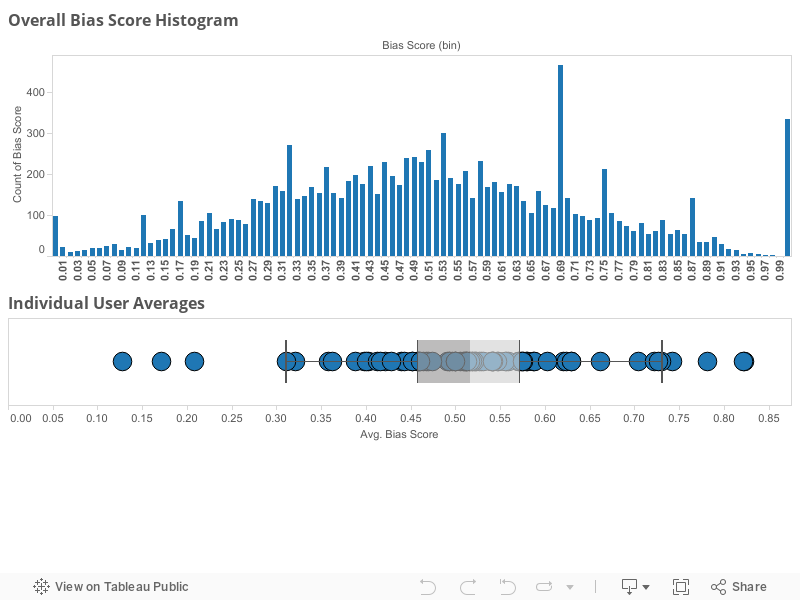
Just a little stuff on the Bias Detector. Overview based on individual users (box & whisker dots act as filter):


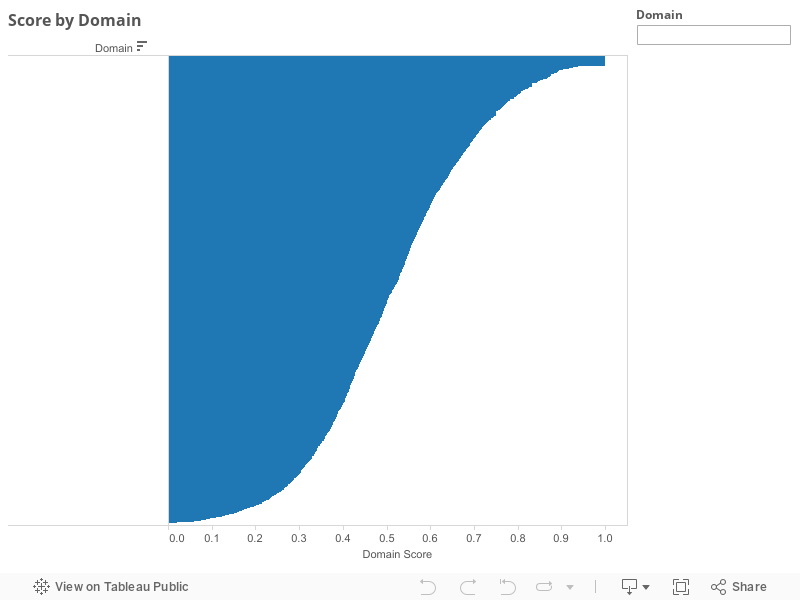
And by domain (compare multiple domains by searching):


Wednesday, March 16, 2016

Comparing Clinton & Bernie Fundraising in the Northwest

I got curious about trends in donations to presidential candidates, and especially Bernie Sanders' claim that his average donation is only $27, so I decided to crack open the FEC numbers.  The national files you can get from the FEC are huge, so I decided to focus on Washington and Oregon.

First, the basics. The records run from April 1, 2015 to February 1, 2016 and include donations from individuals.  PAC and political party donations are not included.  FULL DISCLOSURE: I donated a whopping $3 to Sanders in February. Unfortunately, I'm outside the time range so I don't get to drag his average down further.

Washington


The first observation is that Bernie out-fundraises Clinton because he has triple the donors giving one-third as much per contribution.

The maximum donation allowed is $2700, so I split the donations into small ($100 or less) and maximum ($2700) categories to see how the two candidates do at the ends of the spectrum:


Max donations account for more than half of Clinton's total contributions, while for Sanders they account for about 2.5%.

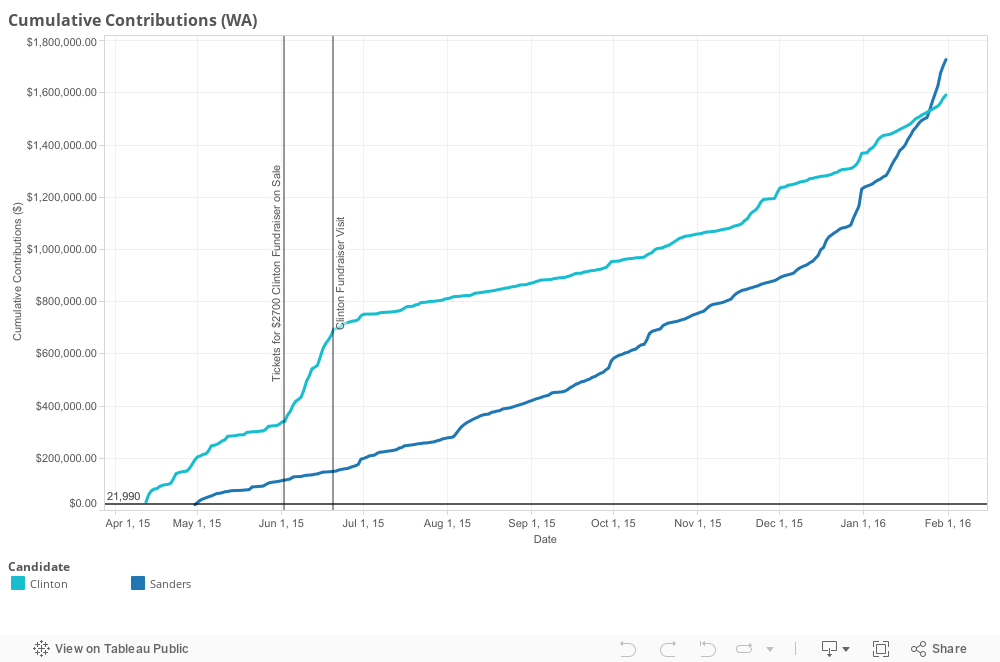
Here is each candidate's cumulative donations over time:


As you can see, Sanders overtook Clinton on January 25 after trailing since the beginning of the season.  Clinton's lead was sustained by a big surge in June 2015.  I checked to see what was going on on June 20, the end of the increase, and found that Clinton hosted a $2700/ticket fundraiser called "Conversation with Hillary" on that date at the Madison Park home of a donor. Tickets went on sale in early June.  Since money is speech, I wonder if Clinton was able to get a word in edgewise.

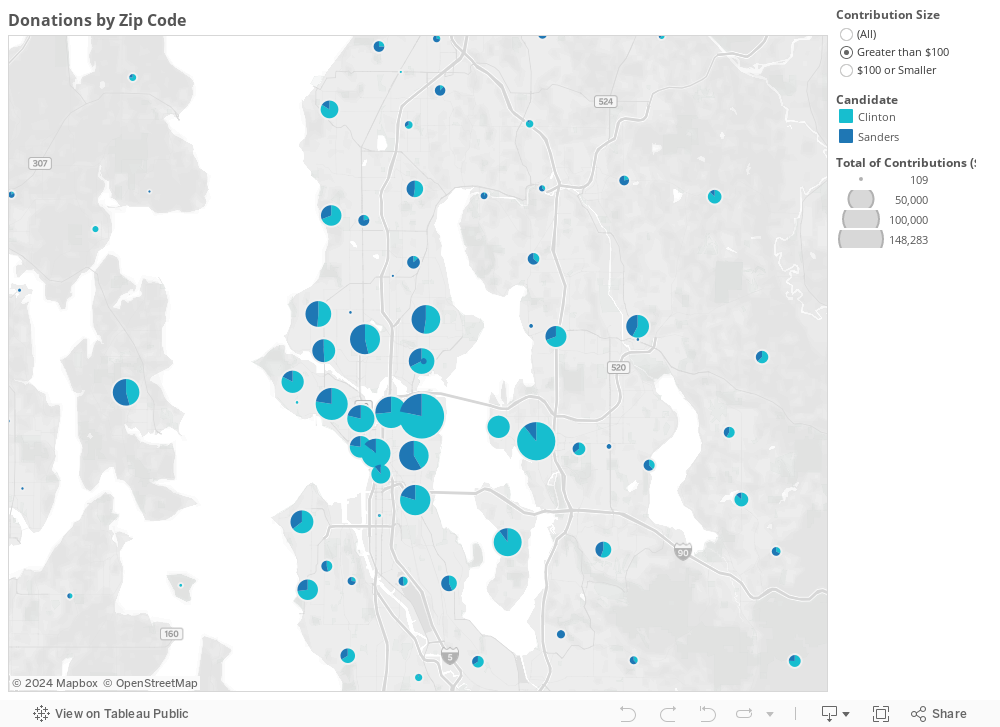
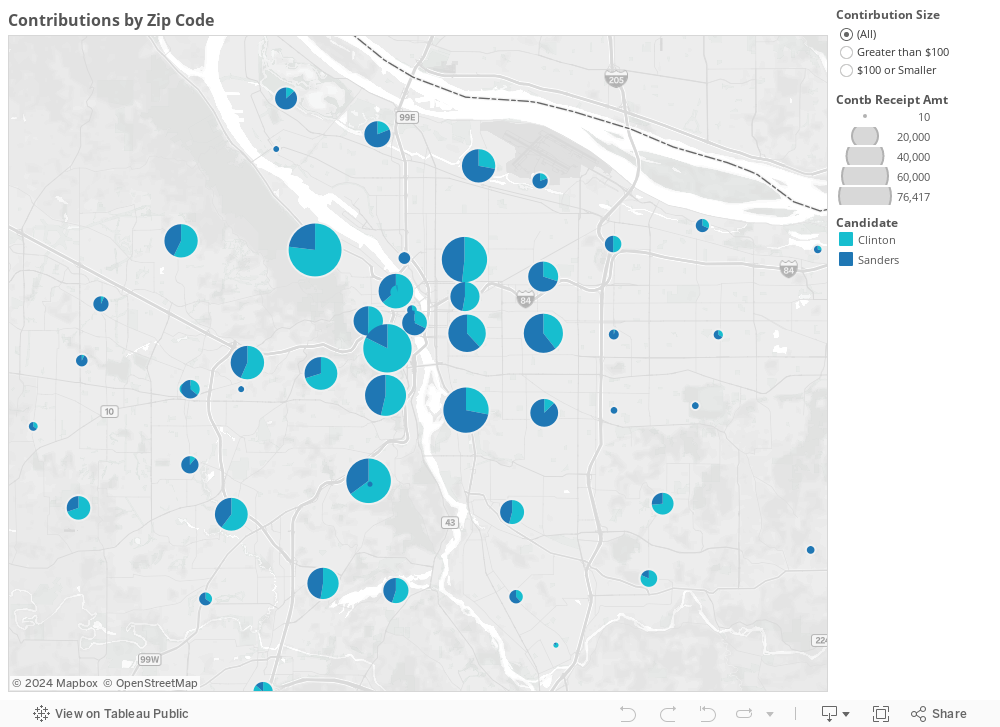
Lastly, here is a map of contributions by zip code.  The pie chart on each zip splits the donations into Clinton and Sanders slices.  Use the tool to the right of the map to filter the contributions into >$100 and <$100 categories:


The difference between the two candidates' shares of small donations and large donations is striking.  Clinton receives a majority of large donations in most zip codes, while Bernie takes an overwhelming majority of small donations in almost every zip code.  

Oregon


The numbers from Oregon tell a fairly similar story.  The summary:


As in Washington, Sanders has more than triple the number of contributors and less than 1/3 the average donation size.  Here's Small vs. Large Contributions:


Again, Clinton draws more than half of her money from maximum contributors; for Sanders, it's 2%.

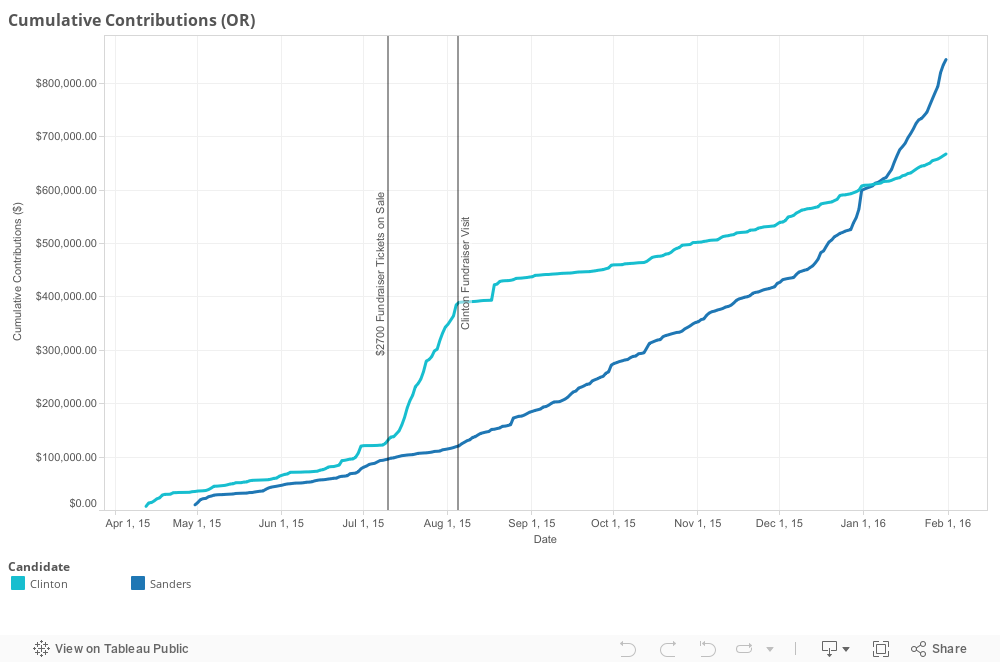
The cumulative contributions tell the same story, down to the Clinton surge ahead of an expensive fundraiser visit.  Tickets for the August 5, 2015 event went on sale July 10. 


The map tells a similar story to Washington, with an even greater polarization between neighborhoods, and small and large donations.  In Portland's Southwest Hills, for instance, Clinton takes 89% of contributions over $100, while Sanders takes 82% of contributions under $100. In my own neighborhood, NE Portland, 98.5% of small donations go to Bernie:


Looking at the map, I noticed that in the Portland area, the Willamette River seems to be a dividing line between Clinton and Sanders fundraising majorities. Sure enough:


There are a lot of conclusions you could draw from this stuff, but to me the basic takeaway is that, at least in the NW, a larger group of individuals of more modest means see Sanders as the candidate representing their interests, while individuals with thousands of dollars of expendable income see Clinton as representing theirs.

Saturday, October 31, 2015

More Team Pursuit Intrigue

Oh yeah baby, it's team pursuit season!  The Cali World Cup is this weekend, which means all sorts of juicy Tissot timing .csv files are hitting the web as we speak.  It's been a while since the days when I pored over my own (hell of slow) pursuit splits, and (for the moment) I'm living vicariously through way faster people.

The US Women's TP in full flight.  Pic from Guy Swarbrick

The TP is a pretty rad mix of anaerobic/aerobic demands, technique, and pacing strategy.  I might crack open the MAOD simulator whirlygig soon to look at the physiological side soon, but since I haven't quite hacked the US National Team's power files yet, I figured I'd look at something simple regarding pacing, especially since the women's race is a good example of how different race situations call for different strategies.

One of the cool elements of TP (and team time trial, which I got to race some of in college) is that the team has to decide how to manage racing with riders of different strengths / aero profiles.  Do stronger riders pull longer at the same speed, faster for the same duration, or somewhere in between? How would having a 6'3" rider drafting behind a 5'7" rider affect length/intensity of pulls?  The conventional wisdom is that constant speed is better than equal-length pulls, since the added stress of accelerating/decelerating as different riders hit the front usually outweighs any benefit.

So is that how it works at the highest level? I got the lap splits from the men's and women's qualifying, first round, and finals races and plotted the standard deviation of lap times vs the team's final race time.  On the graphs, closer to zero on the x-axis means more consistent pacing, and closer to zero on the y-axis means a faster time.  First, the men:


There aren't a ton of data points, but generally, faster teams are also more consistent in their pacing.  On average, for every additional second of lap inconsistency, you might expect a team to go 10 seconds slower (insert large grain of salt).  The limit of just looking at split times is that obviously, all the teams don't start with the same horsepower, resources, training time together, etc.  Given how specialized an event like the TP is, countries that put more resources into training a dialed TP team likely see benefits in both increased strength and technique. (Profound, I know.)

LLLLLLLLADIES!

The positive correlation between lap time consistency and final time was stronger in the women's races--in the neighborhood of 18-21 seconds faster overall per second of lap consistency.

One way to look at the data points is to view points below the regression line as having more horsepower and less consistent pacing, while points above the line have better pacing but less horsepower.  The most interesting example is in the women's final, where Canada beat the US 5:20.1 to 5:25.8.  Despite being in the gold medal ride, the US women had the most lap variation of all eight finals runs.  Here's what the lap splits between the US and Canada looked like:


The increase in the blue line in the last few laps is the US team losing some steam.  One reason they may have slowed down is that they had to burn a big match in the first round (where they rode a 4:21.5) just to make it to the gold medal ride. Another may have to do with the structure of the competition affecting their strategy.  If a team is trying to do the fastest run they can, a consistent pacing strategy is ideal.  But the strategy changes once you're in the gold medal ride where the worst you can get is 2nd place, and you're facing an opponent that has been consistently stronger than you.  In that case, the best option may be to try and match them, even if it means risking blowing up in the final kilometer.  It looks like that's what happened to the US women's team.  But nothing ventured, nothing gained! And they still wound up with a silver medal.

A cool problem would be looking at TP power files and coming up with a way to model the actual cost of inconsistency. But that will have to wait until I want to do something other than some rookie ax+b nonsense.

Tuesday, April 22, 2014

Walla Walla...with Jake!

I went to the Tour of Walla Walla with Jake this year!  

Jake and I got to stay in a child's bedroom with two beds like this:
photo-15
Adorable!

Racing festivities were scheduled to begin on Friday with a 62-mile road race for the men and a bag full of anti-race-development incentives for the women.  That went well until the stage was canceled due to lack of course marshals.  All those snacks for nothing. Next!

photo-14

The TT was a TT.  I beat Jake's triathlon bike, which is the only thing that matters. After team nap time, team coffee time, team pillow talk, team fight club, team shower time, team nail-polish application, and team snacks, we rolled out to the crit.  We parked where we always parked and listened to some kind of country music.

Jake and I wore fluo orange socks for the crit. Flying squirrel tactics defined the first 20minutes of racing. I was astonished at the tremendous sprinting ability that some racers demonstrated out of turn 1 early in the race. Also out of turn 2, 3, 4, 5, and every other point in the race (except for the sprint at like, the end of the race). After coasting with Jake and eating more snacks, I countered a Jacob Rathe/Benny Swedburg/HB move and got away with Dylan Davies of Russ Hays and Darren Goff of Live Well. The three of us were all pretty high on the BMI chart, so we motored and were holding at 15-20s, splitting primes and trying to get some time. Eventually shit heated up behind and we were caught with 1.5 to go. Jake got knocked out of good position due to a last lap crash, but received many congratulations for his strong riding in the breakaway, that popular rascal!

10012453_10203570619371148_9162481438797591505_n

The road race was the usual 90 miles of tailwind climbing. Jake was hurting from the burger I force fed him the night before, so he was in conservation mode. I was feeling good and wanted to find a way to try and win like a #professional instead of defending my 12th place GC, which would have been a #bitchmove. Ian Crane was leading GC, but his main man Carson Miller was momentarily sleepy from pulling like a champ with 35mi to go, so I attacked with Jordan Cheyne (2nd GC) on the more selective tailwind climb, and we had a gap until every other team realized that I might leapfrog them into 9th and started chasing.

Moment of seriousness:  the willingness of people to do the race leader's work for him never ceases to amaze me.  Congrats to everyone who chased us and then missed the actual selection on the last lap:  good job. Actual quote from the race:

"So where are you in GC?"
"Oh, like Xth place." (not 1st)
"So are you going to try and attack?"
"Nah, I'll probably defend."

Heads up: no one is trying to take your top-10 GC spot, which besides is a result that zero people care about.  Going into a race with the mentality that you're not going to challenge the race leader, but that you will challenge other racers who are trying to attack the race leader in order to save the small scraps that you've managed to secure is a pretty lame way to spend a weekend and a couple hundred dollars if you ask me.  Plus it makes Ian Crane's life easier, which no one should ever support.

The real selection came the last time up the same hill, and Jake and I were both too sleepy to go with it. 8 guys including Crane bridged to the small break and went to the line with ~0:45 on our group, which means we dropped way down in team GC, individual GC, and ego size :(((((

Jake gave me San Pellegrino Orange Juice after, which made everything better.  Overall, a great weekend for snacks.

Monday, July 30, 2012

Local Crits

(edited to correct prize purses for Brad Lewis and Derby Days)

It seems like there's a time each year in Washington for a rant concerning prize money inequality between men and women / prize money-to-registration fee ratios.  This year, the rant came right at the end of June, which made sense because a) The Joe Homes threw some chum in the water with a  Facebook post, and b) it was the weekend of Tacoma Twilight, the only local crit of the year to offer zero prize money for any women's field.


First off:  Ivy, if you want lots of minutes per dollar, I think RAAM has a great ratio.

One issue with discussions like these is that they often bring out opinions based on impressions and anecdotal evidence rather than an actual examination of the trends that are being criticized.  So because I only contribute to a discussion if I am completely right about everything ever (which happens surprisingly frequently), I decided to look at some stats from WA crits to see what is going on.  After all, I didn't complete my college education in vain. I completed it in Walla Walla.

All the info here came from results sheets, registration websites, race fliers, and emails with local promoters.

Stats. Ready, go! Let's start with a simple one: total prize purse, men and women combined.


Okay, so I see an outlier. Derby days paid out $8575  across all categories. Next best was Joe Matava at $1831.  They achieved this by paying out 50% of registrations for all women's races, including $425 for the women's Cat 4.

Alright. Objections.  No fair! It doesn't take # of racers into account! Joe Holmes probably packed a ferry with every racer on the entire Island of Kitsap to race and pad his wallet with reg $. Nope. White Bread wasn't even there.  Here's average prize money per entrant.


Okay, that's impressive. $28.84 to second place Tacoma's $6.73.  But Derby Days is probably one of the more expensive crits, so they can pay out more for the same % of registration income, right? Wrong again. Here is prize purse to total registration income.

Pretty much the same as the last graph.  Stop and think about this one for a minute. Derby Days paid out $1.02 for every dollar that it brought in through registration. North Bend was a distant second at 27 cents on the dollar, which they achieved by paying out 50% of reg in all paying categories.  Volunteer Park's purse was middle of the pack, but they brought in so much money from their big fields that they wound up last by this measure at 10 cents on the dollar.

Now, no self-respecting promoter is going to shell out without getting his beak wet first, so where did all of Derby Days' money come from? Joe Holmes gave some answers about that a few years ago.  Go get sponsors.  There is obviously more to the prize purse equation than how much money a race brings in through registration.  There are costs of permits, porta-pots, coppers, officials, insurance, etc., and Joe admits that he saves money by combining Derby Days with an existing street festival, something that not every race has the option to do (why don't we have a naked Fremont solstice crit, btw? Oh, because we would need ink numbers. Plus we would have to see Stangeland topless. Nevermind.).  But even taking that into account,  it should be clear that promoters could do a lot more in terms of making their races more affordable to justify the low prize purse, or increasing their prize purse to justify the entry fee.

Okay, now for the contentious stuff: man vs. woman.  Here's the trend that is the source for most of the complaints from the ladies:

When I look at this, I think, a) Joe Holmes is trying to compensate for something by having the longest bar, and b) women are getting the short end of the stick.  Apparently, having a small women's prize purse is enough to keep the complaints at bay, but it becomes too much to bear when Tacoma  tells women that the joy of racing should be enough for them. I mean the joy of racing and a $20 gift certificate to Pirelli's Pizza.  And an envelope. You can reuse that.  Again, I'm skeptical of whether Joe Matava actually paid out as strong as they did at the women's race.  I'm still waiting to hear from the promoter, but if anyone knows either way, they should let me know. (update: Joe Matava promoters confirmed they paid out 50% to all women's categories)

So you don't need that chart to know that men's purses are almost without exception substantially bigger than women's. But you do need the following chart to show you how much money there is per entrant, male and female, at the races.


This chart takes into account the fact that even though there is generally less money available to women's fields, there are also generally fewer women showing up. Among races that actually paid out to women, all but Ballard and Derby Days actually saw more money per female racer than per male racer.  This illustrates the chicken-and-egg situation: women won't show up if there's lousy money, and promoters are less likely to obtain prize money if they expect low turnout. Vicious cycle! For an individual female racer, it is hard to strike a balance between wanting to hold promoters accountable  and wanting to give them a reason to pay out.  Support a race with a bad purse and you're enabling a trend you oppose; boycott it and you give them a reason to further cut prizes.  Because the group of female racers who might show up on a given race day is a much harder force to organize than the small number of people responsible for gathering prize money for a race, the onus to provide prize money falls primarily on the promoter. "If you build it, they will come" kind of thing. In exchange, women need to be ready to reward responsive promoters with their patronage.

But if you build it, will they come? This chart represents riders per $100 of prize fee. You would expect it to be pretty flat, since races with less prize money would get fewer entrants.

There is no correlation between prize purse and number of racers. Volunteer park gets 36 racers for $100 in prizes, while Derby Days gets 3.  There are a lot of variables at play here. Derby Days was the same day as Boise Twilight and Tour of White Rock, so in spite of its large prize list, it didn't have a big draw.  Bellingham had masters medals up for grabs so it got a lot of racers for an average prize purse. Volunteer Park is like a 2 minute ride from most people in the city.  It had the 3rd smallest purse, but the largest turnout of any crit on the calendar by more than 100 racers.

Here's one take that I think misses the mark:


Yeah, if you don't like it, you can leave! 

A couple of false assumptions here. First, there are a limited number of promoters in the state.  It's not like there are tons of disgruntled promoters who couldn't find a time slot on the calendar and are waiting for someone to make a mistake so they can snatch a spot.  Second, promoters can be lazy and still not be priced out of the market.  The previous chart shows that race attendance is inelastic with respect to prize money. People will still show up, albeit begrudgingly, even if a race has a bad prize purse.  This isn't the first year that Brad Lewis hasn't had a women's purse, yet women continue to come and race.  The economic transaction argument relies on perfect competition and elastic race attendance, neither of which is the case.  Third, telling someone to take a hike if they don't like the way things are is a really shitty way of avoiding problems with the status quo, and is especially easy to do when you're not the one who has it rough.  For perspective, very few, if any racers in the state are going to live and die based on prize money at local crits.  In fact, the situation isn't even burdensome enough that racers are leaving the sport in droves.  But is that really the standard we should use to decide whether or not there is room for improvement in our current system?

The takeaway for me from all this is that promoters can decide whether they want to provide development for the sport by doing the leg work to make racing less financially burdensome for racers, or whether they want to provide a consumer good that transfers more of the cost of racing onto the racers.  Making money off of a race and slacking on finding sponsors is obviously winning with some of the promoters in the area, and the market currently allows them to do that without fear of repercussion.  Luckily for anyone who doesn't like the way things are, the racing community is small, and we don't all have to be price-takers.  #occupyboatstreet
Monday, March 5, 2012

Heading South

My legs hurt because I raced my bike for four days! Here are a few pics from the last week before I go work some more on my stark tan lines.

"My advice would be to ransack the shit out of that shit." That was the last advice I received before Joe and I left Sacramento for the first time on the way down to Merced to race Merco. In another demonstration of the flexibility of our language, "shit" here refers to the pantry of our host house, while "shit" refers to all the food in that pantry.

I was sad to leave our host house, filled as my bedroom was with Bionicles. Luckily for me, our hosts in Merced were enthusiasts of decorative figurines, too! In the reading room, they had a number of totems:


And I couldn't forget their impressive collection of mirthfully-laughing-mothers-of-large-litters-of-children:


And lastly, my favorite of their miniatures. Guess which is the real thing:

(Nissan 350z: PRO!)

(Nissan 350z model--with spoiler! Double PRO!)

But enough about decorative figurines (for now). We didn't come for the decorative figurines; we came to RACE! With a team car and everything! Unfortunately, some teams have bigger budgets than us. For instance, Rabobank didn't just bring a team car, they brought a team building!

(I'ma need to make a withdrawal.)

(Their team car was slightly less [more?] intimidating.)

It was a tough weekend, and we had some bad luck with Cody breaking his elbow in the crit (heal up you fast mafa!). The 8:00 start wound up being just the way Joe described it, but it was good to stretch the legs at something bigger than a local TT ahead of team camp and Sandy Mass in two weeks. Here is some photographic evidence that I raced my bike.

(I'm winning! I'm winning!)

Now I'm back in Sacramento for a few days until a Sprinter van rolls into town, bundles me into the back and delivers my arse from temptation, I mean to Agoura Hills.

Wednesday, February 29, 2012

Defrosting

Well, global audience, all those months of hitting refresh on my blog have finally paid off. I've shed the binding ties (tying binds?) of full-time employment, and since all I have to do for the next several months is travel around racing my bike and do errands for Joe Holmes, I have more time for what's really important.

So I'll start with the shortest of reduxes. After the Skagit circuit race, I decided that wearing anything other than a long-sleeve skinsuit was for total squares because A) no race in the NW is long enough to require you to have anything in your pockets, and B) they make you feel like an eel! So I raced Gig Harbor in one, and got to wonder why Stanko was pulling back every break. Then I got to race Carnation in one, and follow Ian through the picture-skew farm land with its whitewashed fences.


I had been pondering an east coast trip to race GMSR and Chris Thater, but after much consideration of my national resources, and realizing that the RR at GMSR might require me to break my skinsuit streak, I decided to save my pennies so that I could buy some silver bullets for my TT bike instead. Well lucky me because Chris Thater got hurricaned out! And Gabe got to win the KOM shirt at GMSR, which I probably would have won instead if I had gone. You're welcome, Gabe!

So then came the fall and winter. Short summary: hiking, bike touring (with pan-yays), body paint, a love-hate relationship with coffee, and a lot of riding in the Snoqualmie Valley. Maybe I'll go into some of those topics another time. For now I want to talk about emerging from the groggy vitamin D deficiency of winter.

Avid readers will remember that last year kicked off with Cherry Pie road race, and even more controversially, the Jack Frost TT in Vancouver, WA. Well this year I decided to skip the road race and go straight for the controversy. Now. Last year's controversy was a two-part controversy. Part I was when I Tokyo drifted my way to a 30-second penalty and nearly went bowling for Cat 3 Women in the oncoming lane. Part II was Tom's reaction to my post. More drama than an episode of Downtown Abbey.

Well this year was a little less controversial, continuing the theme that, as I become more #committed as a bike racer, my life becomes less and less interesting. So as a non-OBRALAND member, I had to come check in for the TT at 8:00am, even though my start time wasn't until 12:42:30*. So I did, got the OK from the officials that the start times were final, and headed back to my friend's place for breakfast. Then I came back to warm up and race, and what should I find? Well if you looked at the asterisk from two sentences ago, you'd know. I pleaded with the officials, placing a soft towel on the ground so that I could get on my knees to beg without scuffing my leg warmers, and they finally gave me a new time.

(When I warm up, I picture people cheering my name.
In this case, they were shouting "Gibson! You are missing your start!)


So I went and raced, being sure to duck the whole to avoid the booby traps (this was Oregon, so it was technically an adventure race and not a bike race).


So now the off-season is over, hopefully along with my bloff-season.

Now I'm in Merced getting ready for the Merco stage race. There's some serious racers here, but whenever I get scared, Joe Holmes placates me with one of his countless stock phrases. The one that comes to mind is the one I'll leave you with**: "Just remember, all those guys put their shorts on one leg at a time."

*That's right, I expect my readers to refer to foot notes! The officials, some point after telling me that the times were final, moved them all 6 minutes earlier. For all you non-math majors and WWU students, that means my new start time was 12:36:30!!

**Other gems from the trip have included, but have not been limited to:
  • "8:00 start on Sunday? Really? That is--and I mean this in every non-PC way--that is f-----g retarded."
  • "The thing you gotta know about me is, [insert whatever Joe feels like doing at that moment]."
  • "I'm all about getting outside to ride if at all possible." (as he leaves to go ride)
  • "I'm all about cutting your losses." (as he comes back 10 minutes later, drenched)
  • "Oh look, a Prius, ruining everything."

Monday, August 1, 2011

The Flats

It's circuit race season! Every year, HB puts on 3 circuit races, one in Silvana up in the Skagit Flats, one in Gig Harbor near AJ's house, and one in Carnation. These races are always fun, because almost everyone volunteers at them, so we usually have upwards of a dozen guys racing, instead of our usual 10. The Skagit Flats race in 2009 was the first time I felt like I was racing in the 1-2 field instead of just riding and being dumbfounded, so it holds a special place in my heart. That year, Lang even gave me a pair of elite team socks that he stole from Sam. It was a pretty touching moment.

Anyway, now it's 2011, which means there are thousands of b&w and sepia-toned photos of mundane moments during the day circulating on the internet. Let's look at what happened while we volunteered during the early races!

(Winger, sweeping the S out of a corner. Photo Ian Terry)

(Winger mit Radio. Photo wingerstudios.com)

("Tower, this is Ghost Rider requesting a flyby." "Negative Ghost Rider, the pattern is full." Photo IT)

(Ian about to hand me what I thought was a love note as I drove past Trestle 2. It turned out to be an ad from the back pages of The Stranger. Photo IT)

(Winger's Mellow Yellow tire. "You can't beat free." Photo wingerstudios.com)

Thanks to Ian Terry and Langer for riding with me in the my support car Volvo (#swaggerwagon). In the afternoon, we got to shed our reflective vests and walkie-talkies and suit up for some h-core racing of our own. It was a weird one, with a 13-man group going on the 2nd of 8 laps containing me, Steve, Ian Terry and the newly upgraded Nick ZZZ. We all had heavy legs, but they came around in the end just in time for the last lap, when we took turns attacking, setting up the sprint perfectly for me and Steve to go 1-2. Steve pulled the ol' sit-up-when-he-was-sure-his-teammate-was-gonna-win routine, which was confusing, because he was sprinting a LOT faster than me until the last 20 meters.

(Steve, carefully dosing his effort. Photo Amara Boursaw Edwards)

(aw shet bru! that was piiiiiiifect!)

So major booyah on HB winning races. Also, as a result, I got a Cat 1 stamp on my license, so now I get to have my ass handed to me at bigger races, which should help with the issue of my rapidly-inflating ego.

Also in the world of HB, two of our fallen riders, Chris Parrish and Dan Bechtold, are well on the road to recovery and should be racing soon! Get well boys!!!!!

(Chris tucking into a recovery muffin. Muffins contain nutrients that promote the growth of new skull tissue.)

(Dan showing some hip in an obligatory collar-bone-trainer-riding photo.)

Get healthy, get fast!!!!!